Why smart teams run an engineering design review before tooling
A MedTech founder called us last month.
He’d done everything “right” for his injection‑molded housing:
- Prototyped and iterated
- Run DFM reviews with his machine shop
- Landed on a solid design that met requirements
Before pulling the trigger on roughly $100K in tooling, he wanted one more set of eyes on the CAD.
Frankly, I’d have done the same. It’s hard to see the forest when you’ve been staring at one leaf for weeks.
After 175+ projects in MedTech, aerospace, defense, and federal research, one pattern is clear:
call before there’s a problem, not after.
Chad is a professional engineer and has spent over 25 years leading complex engineering projects in medical device development and defense systems. He's been hands-on from early-stage prototyping to full-scale manufacturing, giving him unique insights into the challenges of bringing devices to market. Chad is always thinking about how to improve the development process to help clients save on manufacturing costs without reducing quality.
What we found in the design review
In a focused engineering design review, we flagged:
- Tolerance stacks that could bite during assembly
- Small geometry tweaks to make molding and ejection more forgiving
- A material callout that would have complicated sourcing
Nothing dramatic. Nothing that would have sunk the project.
Exactly the kind of issues that add weeks and dollars if you catch them after tooling instead of before.
He made the changes. Ordered tooling. Parts came out the way he intended.
Design reviews that keep projects smooth (4 examples)
These aren’t “save the project” stories. They’re “make sure the project goes smoothly” stories.
Aerospace ground support equipment
A top US rocket manufacturer needed custom ground support equipment for 7 m‑diameter, 4,000 kg parts. Critical components were arriving soon and there was no system to handle them. We designed and delivered adapter bases, lift carts, and a rotational fixture in 10 weeks, so inbound parts had places to go on an ever‑shrinking factory floor.
The adapters and the lift carts have been indispensable for an ever shrinking factory floor.
Wireless power demo hardware
A small startup had a working prototype and a critical customer demo in 4 weeks. Instead of hoping the prototype would survive travel and a conference room full of executives, they asked us to harden the electronics and build a simple, professional enclosure. We turned it around in 2 weeks so they had time to test and finish their side of the work.
Root3 has been an invaluable partner in helping IVO rapidly prototype and scale our technology.
User‑centered prosthetic design
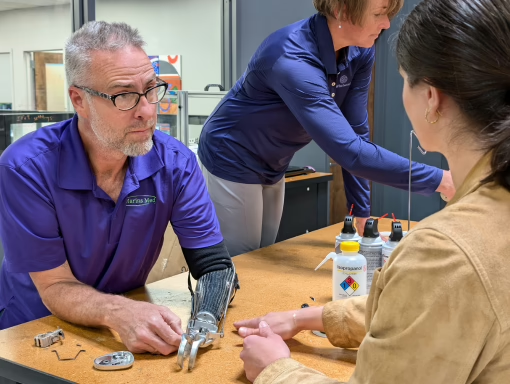
A founder who uses a mechanical prosthetic hand wasn’t satisfied with existing options. He had a prototype, but it wasn’t reliable. We explored tolerances in the complex mechanism and built multiple prototypes. When we handed him a prototype and said “be careful with it,” he posted a video crushing a soda can.
They consistently meet our complex challenges with practical solutions and are always available for conversations.
Pharmaceutical flavoring hardware
A MedTech company had an automated medication dispenser in the field. Some parts were cracking and leaking. Through chemical compatibility testing (including soak tests over two months), we found a material mismatch and worked with their molder on a new recipe with filler to match the original shrink rate. No new molds required.
We’ve worked with the Root3 Labs team on several projects… quick response, in‑depth subject knowledge, and effective product changes.
When should you schedule an engineering design review?
The best time to run an engineering design review is before you commit to expensive, hard‑to‑reverse decisions, such as:
- Tooling for molded, cast, or stamped parts
- Selecting suppliers for critical components
- Major test events or regulatory submissions
A focused review at that point catches:
- Tolerance issues
- Material and process choices
- Assembly and test risks
while they’re still cheap to fix.
The Best Time for a Review?
Early enough that recommendations are still cheap to fix.
One thing to try this week
If you’re deep in a design, get a fresh perspective:
- Talk to a customer
- Ask an engineering colleague
- Call your manufacturing partner
Ask one question:
“What do you see that I might be missing?”
Their questions may surface an assumption you haven’t verified or a part with a 28‑week lead time.
If you’re staring at a decision point (tooling, supplier selection, test strategy) and want a second set of eyes, that’s exactly why we offer a focused hardware design review phase before clients commit.
You can contact us to walk through a typical scope, or simply request our design review template to use with your own team.