Updated October 12, 2026
Compare cost, speed, technical coverage, control, and long-term ownership to determine the right engineering model for your project.
Overview: Outsourced Engineering vs. In-House Engineering at a Glance
Keep engineering in-house when the work is steady and the capability is central to your product. Bring in an outside team for a defined milestone, temporary capacity, or a discipline you do not need full time. Use a hybrid model when your team needs to retain product ownership but could use outside help with design, analysis, prototypes, or testing. Compare the total effort and cost to reach the next decision, including handoff and delay, rather than salary against an hourly rate.
When a product needs engineering support, the decision is not always as simple as hiring an employee or handing the entire project to an outside firm. Ask what work needs to be done, when it needs to be done, and which technical decisions and knowledge your company needs to own over time.
A team may need steady, day-to-day engineering ownership, a specialized capability for one phase of development, or outside support to pressure-test a design before committing more time and money. This guide compares the options across cost, speed, technical coverage, control, infrastructure, and continuity.
Outsourced Engineering vs. In-House Engineering at a Glance
| Factor | Outsourced engineering | In-house engineering |
|---|---|---|
| Best fit | Defined projects, temporary capacity, specialized work, and deadline-driven programs | Continuous engineering needs tied closely to the company’s core technology |
| Speed to start | An established team may begin sooner once scope, availability, and technical context are clear | An existing team may start immediately; a new hire needs recruiting and onboarding |
| Technical coverage | Access to multiple disciplines as the project requires them | Limited to the skills represented on the internal team |
| Cost structure | Project-based, hourly, or fractional costs without permanent headcount | Salary, benefits, recruiting, software, equipment, management, and ongoing overhead |
| Control | Requires clear communication, documentation, and decision ownership | Direct day-to-day management and close organizational integration |
| Scalability | Add or reduce support or disciplines as project needs change | Team capacity and capabilities are fixed once employees are hired |
| Institutional knowledge | Transferred through documentation and collaboration | Knowledge remains directly within the company, but internal documentation is a good habit. |
| Facilities and equipment | May include access to specialized software, testing equipment, and fabrication capabilities | Must be purchased, maintained, or accessed through additional vendors |
Neither option is universally better. The goal is to match the engineering model to the work, rather than forcing the work into the team structure you already have.
When Does Outsourced Engineering Make Sense?
Outsourcing is often the better fit when the need is urgent, specialized, temporary, or difficult to support with the current team. An outsourced engineering team may be the better fit when:
- You have a defined project or milestone.
- You need specialized mechanical, electrical, embedded, or development capabilities that differ from your long-term manufacturing engineering needs.
- Your internal team does not have enough capacity.
- A customer demonstration, test event, or production deadline cannot wait for a hiring cycle.
- You need access to fabrication facilities, testing equipment, or specialized software.
- You want an independent perspective before making an expensive decision.
- The workload does not justify another permanent hire.
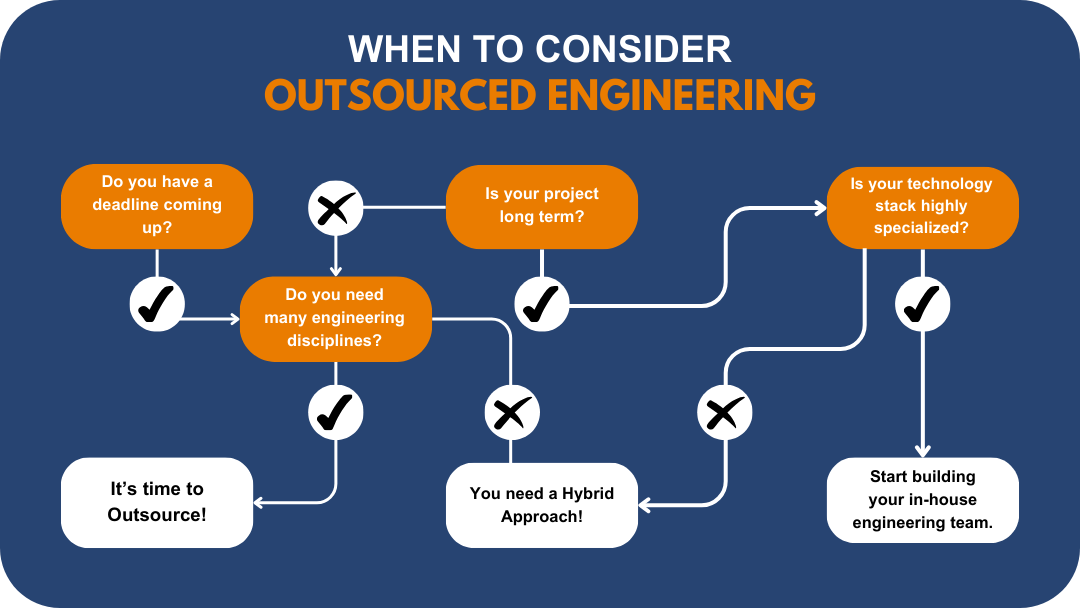
It can also help teams get a second set of eyes before tooling, supplier selection, or another difficult-to-reverse decision. An independent engineering design review can identify untested assumptions, manufacturing risks, or missing evidence while changes are still easier to make.
For example, an aerospace manufacturer needed custom equipment to handle large composite rocket components before critical parts arrived. Root3 Labs worked closely with the customer’s internal team, developed concepts for the adapter and transport lift system, completed a Critical Design Review in week three, and delivered the ground support equipment on the project schedule. The customer supplied the manufacturing context; Root3 took on the defined design, analysis, fabrication, and testing work. This is the kind of milestone-bound need that can suit an outside team.
Read the ground support equipment case study for the project details.
- Engineering is a continuous core function.
- You have enough consistent work for a full-time role.
- The work requires deep knowledge of your product, customers, or operations.
- The engineer needs to collaborate with other departments every day.
- Long-term internal ownership is more important than short-term flexibility.
- You consistently need the same technical discipline.
Before hiring, consider whether you need one capability year-round or different capabilities during each project phase. A full-time engineer may be busy during detailed design but underutilized during testing, regulatory review, or supplier qualification.
If the same expertise will remain central to the product, bringing it in-house can make sense. If the need rises and falls with the work, a permanent hire may not be the most practical answer.
What Does Outsourced Engineering Really Cost?
Comparing an external firm’s hourly rate with an employee’s hourly salary does not provide a complete picture.
The cost of an internal hire may also include:
- Recruiting and interview time
- Payroll taxes and benefits
- Paid time off
- Management and training
- Engineering software
- Computers, lab equipment, and workspace
- Underutilized time between project phases or once the project is complete, especially when hiring for a short-term need.
- Delays while searching for the right candidate
Outsourced engineering has its own cost considerations. The engagement may carry a higher visible hourly rate, and unclear requirements can create avoidable rework. Internal stakeholders must also spend time sharing context, reviewing work, and making decisions.
A better comparison is the total cost required to reach the next meaningful milestone, not the apparent hourly cost of each engineer.
That includes the cost of delay and rework. A lower hourly rate matters less if the wrong technical assumption survives long enough to affect fabrication, tooling, qualification, or a production build.
For each option, estimate the disciplines, equipment, internal management, and time needed to complete that milestone. Then ask what a delay, failed build, or repeated piece of work would cost the program. If you are not able to answer any of those questions, that may be a sign it’s time to bring in outsourced expert engineering judgement.
The Hybrid Approach
Many companies do not need to choose one model exclusively.
A hybrid engineering model allows the internal team to retain product ownership and long-term technical knowledge while an outside team provides:
- Specialized engineering capabilities
- Additional capacity during a deadline
- Prototype fabrication and testing
- Independent design reviews
- Support during a specific development phase
- Senior technical guidance
This can be especially useful when the internal team knows the product deeply but does not need every supporting discipline on staff full time.
For example, an internal product owner may manage requirements and priorities while an outside multidisciplinary team completes the design and testing work. An external team may also develop and test a prototype before transferring the design to the internal team.
In other cases, the outside team may only own one part of the work, such as an FEA study, test fixture, design review, or manufacturing-focused redesign, while the internal team remains responsible for the broader program.
Companies that need ongoing technical direction without a full-time executive hire can also use fractional engineering leadership to support hiring, planning, technical decisions, and team development.
Questions to Ask Before Deciding
Use these questions to evaluate the options:
- Is the need ongoing or tied to a specific milestone?
- Which disciplines and facilities are needed, and does the existing team have capacity?
- Who must own the requirements, technical decisions, and long-term product knowledge?
- How soon must work begin, and what would a delay or failed build cost?
- What documentation or design transfer will the next team need?
- Will the same technical capability still be needed six or twelve months from now?
How Do You Choose the Right Engineering Model?
Choose an in-house team when engineering is a continuous business function, the workload is predictable, and long-term internal ownership matters most.
Choose outsourced engineering when you need specialized capabilities, additional capacity, facilities, or a faster path to a defined milestone.
Choose a hybrid model when your internal team should retain product ownership but needs outside support to move the work forward.
The better choice is usually the one that fits the actual engineering need, not simply the option with the lowest visible hourly cost or the easiest org chart.
Root3 Labs supports hardware teams with detailed engineering, prototype fabrication and testing, design reviews, and manufacturing preparation. We can take on a defined project or work alongside your existing team.
See how Root3 Labs approaches product development or discuss your engineering needs.
Written By: Chad Schneider, MSE, P.E
Originally published April 16, 2024 | Updated October 12, 2026
Frequently Asked Questions
Is outsourcing engineering cheaper than hiring in-house?
It depends on the workload and timeframe. Outsourcing may cost more per hour, but it avoids recruiting, benefits, equipment, software, and permanent overhead. Compare the total cost of reaching the next project milestone rather than hourly rates alone.
What engineering work can be outsourced?
Companies commonly outsource product development, mechanical and electrical engineering, embedded systems development, prototype fabrication and testing, design reviews, test fixtures and ground support equipment, design for manufacturing, and product troubleshooting. They also outsource tasks that are short-term or a resource that continues long-term on a fractional basis.
Can an outsourced engineering team work with our internal engineers?
Yes. A hybrid model allows your internal team to retain product knowledge and technical ownership while an outside team provides added capacity, specialized capabilities, or support for a specific development phase. Agree on decision ownership, reviews, and documentation before work begins.
How do you choose an outsourced engineering firm?
Look for relevant technical experience, clear project scoping, strong documentation, consistent communication, and the facilities needed to complete the work. Ask who will work on the project, how decisions will be managed, and what will be transferred to your team at the end.
What if we are not sure which engineering model we need?
Start by defining the next decision or milestone rather than the type of resource you think you need. Root3 Labs can help determine whether the work calls for a defined project, an engineering design review, ongoing support, or an internal hire.
What should we agree on before an outside engineering team starts?
Define the next decision or milestone, scope of work, requirements, decision owners, review points, and the evidence and documentation the team will deliver. If those are unclear, start by resolving them before estimating the whole program.
Still have questions?
Need help deciding between outsourcing your engineering services or building an in-house team? Our experienced R&D firm can help you evaluate your options and create an engineering strategy tailored to your project needs.