Engineering Services from Credentialed Experts
The intricate world of hardware development for medical, aerospace, and defense applications demands more than experience alone. Getting to a successful product requires a multi-faceted approach, combining technical engineering expertise with project management, regulatory compliance, business acumen, and a deep understanding of the industry. It’s critical that your engineering partners are well-rounded, multidisciplinary, credentialed experts.
At Root3 Labs, we take pride in having a team made up of highly credentialed engineers who bring a diverse range of expertise to the table. This ensures that every project we undertake benefits from a comprehensive understanding of the device development lifecycle, from ideation to mass manufacturing.
What does this mean for your project?
- Licensed professional engineers that can sign-off on safety-critical analyses and design changes your Quality & Regulatory teams can trust.
- Graduate degrees in mechanical engineering and medical robotics for complex electromechanical systems, modeling of materials, loads, and failure modes, not just designing simple widgets.
- Technical entrepreneurship training means we’re thinking from prototype through manufacturing, commercialization, and business success, not just ‘cool CAD.’
Credentials for Decision-grade Engineering Services
You’re sure to see an alphabet soup of letters behind our names! PE, MSE, MTE, MEng…What do they all stand for? Each of these abbreviations of academic and professional credentials reflect our passion for engineering, so we’re proud to highlight them and how they’re such a valuable asset for our team!
Professional Engineers for Technical Expertise
Professional Engineer (PE) is a qualification license issued by a State’s Board for Professional Engineers and a requirement for performing any engineering consulting services in Maryland and most other US States. Our team boasts two licensed PEs, and two Engineers-In-Training (EIT) that are working toward their PE.
Professional Engineers must first earn a Bachelors degree from an ABET-accredited engineering program and pass the FE (Fundamentals of Engineering) Exam. This 110 question exam takes 6 hours and covers a variety of engineering topics. Passing the FE Exam begins the EIT program which requires at least four years of engineering experience under the supervision of two or more Professional Engineers. After that time, candidates go through an extensive application and review process to be able to take the PE Exam in a specific discipline.
Chad, our founder, and Christina, a Partner & Senior Engineer, both passed their PE Exam in the Mechanical discipline. Specifically, Machine Design and Materials, which is an 80-question, 8-hour exam that requires months of preparation! Having their expertise when it comes to product safety and technical engineering analyses means that we can provide qualified and professional work to all of our clients.
Solving Complex Engineering Problems
Several members of our team also hold graduate engineering degrees. The Masters of Science in Engineering (MSE) is a 2 year graduate program that often involves both academic classes and original research with a thesis project. The Masters of Engineering (MEng) is a 1- to 2-year program of 10 advanced academic classes. Both programs can focus on one of many engineering disciplines or integrate academic programs to study something multi-disciplinary.
Chad, our founder, has a MSE in mechanical engineering and medical robotics alongside his PE license! Todd also has an MSE in mechanical engineering and medical robotics (they met in grad school). Having their degrees of expertise spread throughout different engineering disciplines means that we’re always able to handle multi-disciplinary project and device needs! And with the ever evolving technology of the modern world, device needs continue to become more and more complex with many intersecting engineering disciplines required.
Entrepreneurial Training for Engineering Expertise
A unique strength of our team lies in the presence of members with Masters of Technical Entrepreneurship (MTE), UMD QUEST Total Quality Management, and Goldman Sachs 10,000 Small Businesses qualifications. This background fosters a comprehensive understanding of the entire device development lifecycle. We look beyond the technical engineering solution think about how we can help our customers build great businesses, profit margins, sales & marketing, and the best experience for their customers.
Cybersecurity Compliance
When you’re developing hardware for defense or aerospace programs, cybersecurity isn’t optional. It’s a contract requirement. But, for commercial customers, it’s a factor that’s often overlooked. If your engineering partner loses all their work to malware data corruption or ransomware, where will that leave you?
Here’s what the acronyms actually mean, and why they matter:
DFARS 252.204-7012 is the Defense Department’s cybersecurity clause. It requires contractors handling Controlled Unclassified Information (CUI) to implement specific security controls and report cyber incidents within 72 hours. If your contract has this clause (most defense contracts do), you must comply—or you’re in breach of contract.
NIST SP 800-171 v2 is the actual standard behind DFARS 7012 developed by the US National Institute for Standards and Technology. It’s 110 security controls covering everything from access control, data integrity & backup processes, and encryption to incident response, data recovery, and personnel screening. Think of it as a cybersecurity checklist for protecting sensitive but unclassified government data on contractor systems. Note: Rev 3 has been published but not yet adopted.
CMMC Level 2 is the verification layer demonstrating compliance with each of the 110 security controls. The Cybersecurity Maturity Model Certification requires a documented self-assessment or a third-party audit to prove it.
Why does this matter?
At Root3 Labs, we’ve already done the work:
- DFARS 7012 compliant with 110 NIST 800-171 v2 controls implemented
- CMMC Level 2 Self-Assessment submitted to the Supplier Performance Risk System (SPRS)
- 72-hour cyber incident reporting process in place
This means when you engage us on a defense or aerospace program, cybersecurity isn’t a blocker. You don’t have to wait for us to get compliant. You don’t have to worry about supply chain risk. You can move forward. For commercial customers, you can have confidence that we take cybersecurity extremely seriously and have implemented systems to protect our data and yours.
That’s what de-risking looks like in practice.


Diversifying Disciplines to Collaborate for Success
At Root3 Labs, we strongly believe that collaboration between a close, multidisciplinary team is the best way to succeed at product development. A great example of this philosophy at work is our Smart Badge project. With a tight development window of only one month, we knew the only way to get there was to leverage the diverse expertise of our engineers by having them work in tandem from start to finish.
Imagine the roadblocks we might have encountered if we relied solely on the expertise of just one engineering discipline. The PEs on the team, for example, brought their regulatory knowledge and mechanical know-how. Meanwhile, the MSEs, with their deep understanding of complex medical technologies, helped tackle intricate design challenges between electrical and mechanical. Ultimately, they were able to best optimize the Smart Badge’s functionality by streamlining the development process and collaborating closely.
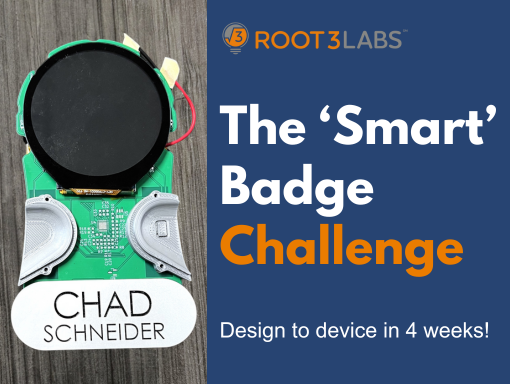
This collaborative development process was the cornerstone of the project’s success! By constantly communicating and working in tandem, we were able to overcome obstacles quickly, adapt efficiently, and ultimately deliver the Smart Badge within that challenging time frame.
Collaborative spirit is at the heart of Root3 Labs’ approach to Device Development. By fostering a culture that values diverse perspectives and encourages teamwork, we empower our clients to bring their innovative ideas to life. Are you ready to embark on your own medical device project? Download our comprehensive Product Development Guide to gain valuable insights and learn how Root3 Labs can help you achieve success.