“The Prototype Trap”: Fast prototypes. Slow, painful production.
Here’s something I don’t see talked about enough:
A lot of R&D teams get stuck between two types of vendors.
On one side: rapid prototyping shops that can build anything, fast. They’ll 3D print your enclosure in 48 hours. Machine your brackets same-week. No questions asked.
On the other side: full-service CDMOs with ISO 13485 QMS, pilot lines, and supplier qualification processes. They’re ready for production. But they’re expensive, slow to engage, and often won’t touch early-stage work.
So what happens?
Teams prototype fast with Shop A. Then they hit a wall when they try to transition to Shop B for production. The prototypes don’t translate. Tolerances don’t stack right. Materials aren’t production-viable. Documentation is thin.
The root cause usually isn’t “bad prototypes.” It is prototypes that were never designed for manufacturability or pilot production in the first place.
This is the prototype trap. And it’s avoidable.
Chad is a professional engineer and has spent over 25 years leading complex engineering projects in medical device development and defense systems. He's been hands-on from early-stage prototyping to full-scale manufacturing, giving him unique insights into the challenges of bringing devices to market. Chad is always thinking about how to improve the development process to help clients save on manufacturing costs without reducing quality.
7 Questions to Ask Your Current Team
Whether you’re working with an internal team, a prototype shop, or an engineering firm, these questions will tell you if you’re on track for a smooth production transition—or setting yourself up for a redesign.
1. “Can you show me the tolerance stack analysis for this assembly?”
If the answer is “we’ll do that before tooling,” you’re already behind. In DFM, tolerance stack-up is a pilot-build problem, not a paperwork problem.
2. “Which materials in this design are production-viable at volume?”
3D printed ABS is great for proof-of-concept. Ask which materials and processes are production-intent and which are “prototype-only assumptions.”
3. “What does the manufacturing documentation and design transfer package include?”
You need more than CAD files. Ask for: detailed drawings with GD&T, BOMs with approved suppliers, assembly instructions, test procedures, and risk files. If they say “we’ll document it later,” ask when—and get it in writing.
4. “Have you built low-volume, production-intent pilot units, not just one-off prototypes?”
There’s a difference between “we built a prototype” and “we built 25 units the way your CM will build 10,000.” Pilot production exposes assembly issues that single-unit prototypes hide.
5. “How do you handle design changes during development?”
Traceability matters. If a requirement changes, can they show you what drawings, BOMs, and test procedures updated as a result? If not, your CM will inherit chaos.
6. “Will you support the Contract Manufacturer handoff?”
The best teams don’t just deliver files. They join calls with your CM. They answer RFQs. They help resolve first-article issues. If they disappear after delivery, you’re on your own.
7. “What’s one thing you’d change if you had to build 1,000 of these?”
This question reveals whether they’re thinking about scale. If they can’t name anything, they haven’t been designing for production.

What a DFM + pilot-ready partner actually does
I’ll be candid. At Root3 Labs, we’ve learned these lessons the hard way. Here’s what we do now—whether or not a client ends up working with us long-term:
DFM from day one, not as a gate. That includes designing around realistic process capability, not nominal CAD. We ask “How will this be manufactured?” during the first sketch. That means selecting materials that exist in production volumes. Designing tolerances suppliers can actually hold. Building in assembly logic that doesn’t require a PhD to execute.
Full manufacturing documentation. We create the complete package: detailed drawings, BOMs, assembly instructions, test procedures, and risk files. Not just enough to build a few units—enough to transfer to a CM with confidence.
Pilot production, then handoff. We build low-volume, production-intent runs of 10–50 units to flush out assembly and yield issues before your CM has to. Then we work directly with the Contract Manufacturer to ramp up. No thumb drive of CAD files tossed over the fence.
Documentation that travels. AirMid Critical Care put it this way: “In each case, the development work was achieved on time and within budget, with correct documentation needed for internal QMS / ISO 13485 processes.”
How do we bridge from Prototype to Production?
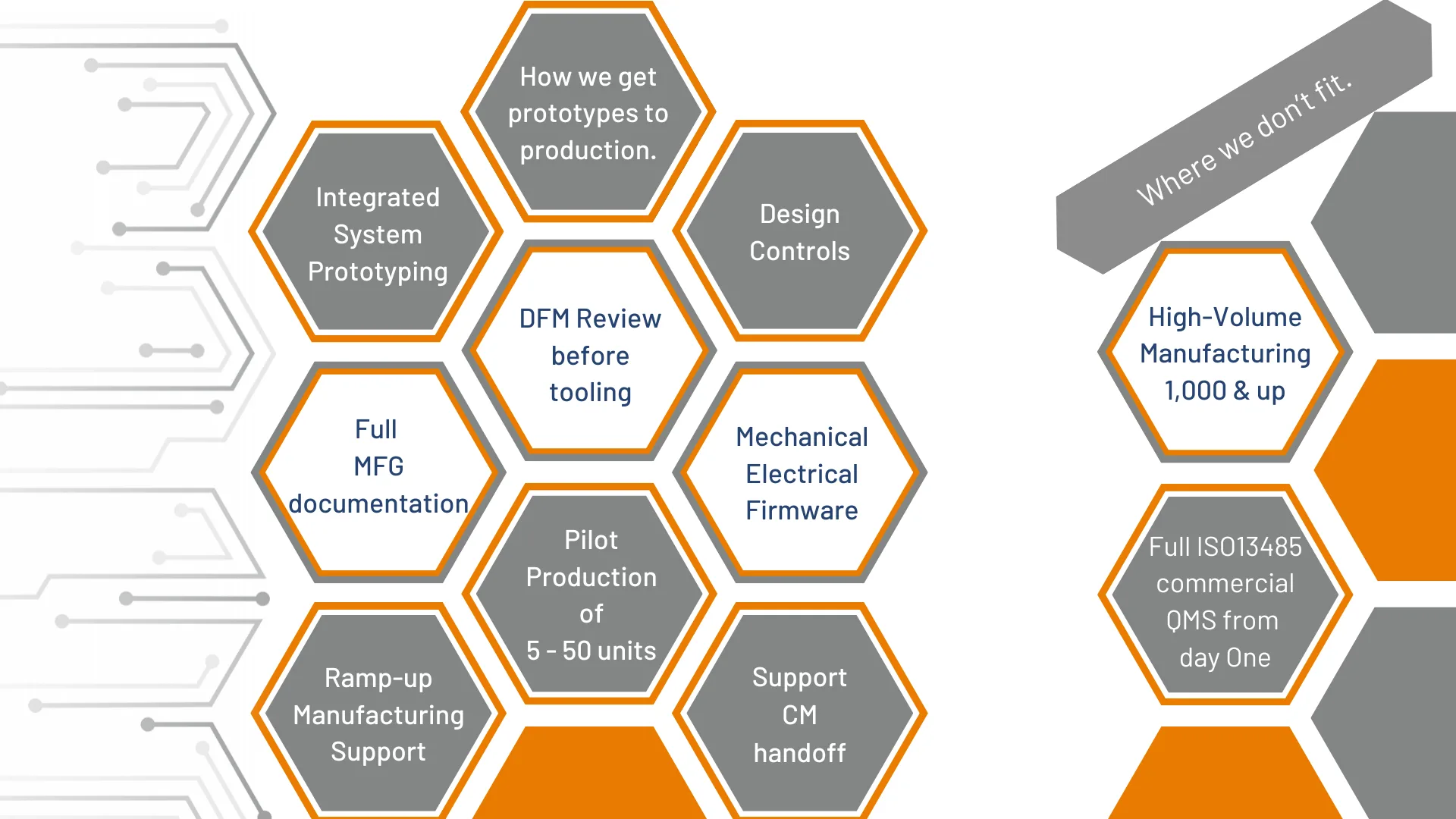
Root3 Labs sits between the fast‑but‑shallow prototype shop and the fully regulated CDMO. Use us when you want prototypes that are designed to survive pilot production, not just the demo.
We’re a fit if you need:
- Integrated system prototyping (mechanical + electrical + firmware)
- DFM review before tooling
- Design controls and traceability during development
- A full manufacturing documentation package (drawings, BOMs, assembly, test, risk)
- Pilot production runs of about 10–50 units at production intent
- Hands-on Contract Manufacturing handoff and ramp-up support
We’re probably not the right fit if you need:
- High-volume contract manufacturing (on the order of 1,000 units and up)
- A full ISO 13485 commercial QMS in-house from day one
If you need high-volume production or a full QMS from day one, we’ll tell you that upfront and point you to a better-suited partner.
Real Outcomes
Coram Technologies: We conducted a DFM review before tooling, then built the first 50 production units. First articles passed. No redesign. No surprises.
My group has collaborated with Root3 on two of our projects over the past three months, and their contributions have exceeded our expectations.
We’ve enjoyed working with Root3 so much that we plan to continue consulting them on future projects. I would recommend Root3 to any of my colleagues who might need engineering or design assistance.
Root3 Labs was key in bringing to market a pharmaceutical flavoring and water dispenser. They addressed several defects that another company was responsible for… Had we used them from the start we would have been to market several years sooner.
That last line hits hard. But it’s honest.
They didn’t come to us for heroics. They came to us because their prior work wasn’t manufacturable. We fixed it. But the real win would have been catching those issues before the first prototype was built.
The lesson: Smart teams don’t call us to save the day. They call us early so there’s nothing dramatic to save.
One More Question
I’ll leave you with this:
“Exactly which features locate this part, and where have we given the system room to breathe?”
If you can’t confidently answer at least 4 of the 7 questions in this email, that’s exactly what our Engineering Design Review is for. In a short, focused review, we:
- Run a DFM check on your current prototype
- Flag tolerance and material choices most likely to fail at pilot builds
- Outline the minimum documentation your CM will expect at handoff
If you want that outside set of eyes, you can request a 30-minute scoping call here.
P.S. If you’re already working with a CDMO or prototype shop, that’s fine. We’re not here to replace them. We’re here to make sure your next handoff doesn’t turn into a redesign. Use the 7 questions above—they work with any vendor.
Root3 Labs is a PE-operated hardware engineering firm helping MedTech, aerospace, defense, and advanced hardware teams turn technical uncertainty into decision-grade proof. Through focused prototypes, design reviews, test systems, applied R&D, and manufacturing-minded engineering, Root3 helps teams build quality in early and move forward before the next expensive commitment.