What advanced hardware teams need to prove to move products from the lab to the real world.
Technology Readiness Levels give product development teams a common way to describe technology maturity across different stages of development. These definitions are useful, but are often the easy part. The harder question is what the current evidence actually supports, and what still needs to be proven before the program moves forward.
What proof does a hardware team actually need to move from TRL 4 to TRL 7 without discovering critical risk too late?
That is the question this field guide is designed to help answer. Bookmark this page if your team is moving hardware out of the lab and needs to know whether the current evidence is strong enough for the next milestone.
In this field guide:
- Technology Readiness Levels 4-7 at a Glance
- Why Programs Stall After the Lab
- Why TRL 4-7 Matters to Root3 Labs
- How to Make Progress From One Readiness Level to the Next
- How Do You Move From TRL 4 to TRL 5?
- How Do You Move From TRL 5 to TRL 6?
- How Do You Move From TRL 6 to TRL 7?
- Where Technical Risks Hides as Hardware Moves Out of the Lab
- What Evidence Should Support a Technology Readiness Assessment?
- When Outside Engineering Support is Useful
- Before the Next Milestone
Technology Readiness Levels 4-7 at a Glance
A Technology Readiness Level, or TRL, describes technology maturity based on what has been demonstrated and under what conditions. NASA’s Technology Readiness Level framework uses nine readiness levels, beginning with basic principles and ending with technology proven in successful operations. For hardware teams working through the middle levels (4-7), the important question is not just where the technology sits, rather what the evidence actually proves.
| Level | What needs to be proven | The question that matters |
|---|---|---|
| TRL 4 | The critical components work together in a laboratory setting. The team should have enough test data or analysis to separate what is known from what is still assumed. | What do we know now, and which assumptions still need proof before the design moves forward? |
| TRL 5 | The technology still performs when it is tested under conditions that better reflect how it will actually be used. That may include loads, temperature, vibration, duty cycle, interfaces, or other application-specific conditions. | Which real-world conditions could invalidate what worked in the lab? |
| TRL 6 | The integrated system or subsystem performs under conditions that reflect how the hardware will actually operate. The evidence should address the interfaces, requirements, and failure risks that matter to the next major program decision. | Does the integrated system give us enough evidence to support the next major commitment? |
| TRL 7 | The prototype performs under actual operating conditions, with the major technical risks understood well enough to support the next program decision. | What has been proven under actual operating conditions, and what still needs an answer? |
The progression looks orderly on paper, but real hardware rarely follows a clean path. As the system moves closer to actual use, assumptions that were acceptable earlier in development need stronger proof because more is riding on them.
The number isn’t the objective. The evidence behind the number is.
Why Programs Stall After the Lab
The “valley of death” commonly refers to the difficult stretch from TRL 4 through TRL 7, where a technology has to move beyond early lab proof but still needs the evidence required to move toward real-world use.
In its 2025 Manufacturing USA assessment, the U.S. Government Accountability Office uses the term for the gap between early-stage R&D and later commercialization by industry.
For hardware teams, that gap often shows up as unresolved technical proof. A prototype may work on the bench, but the team may not yet know whether it will perform the same way under the conditions it will actually face. A subsystem performs well on its own, but the interface to the larger system is still changing. A test may hit the target once without proving that the result will hold under vibration, load, temperature, or repeated use.
What this looks like in practice: We build product development prototypes all the time to uncover risk early without unnecessary investment. In one particular case, we were attempting to understand whether an installer could reach into a recessed cavity to connect small antenna and cable connectors. The team built a cardboard prototype in under an hour and answered that question before committing to sheet metal.
Those are not signs that the earlier work failed. They are signs that the next stage is asking a different question.
As hardware matures, the evidence has to mature with it. The test that was enough to support one decision may not be enough to support the next.
That is where programs can stall: not because the technology stopped working, but because the current evidence is no longer enough for the decision ahead.
Why TRL 4-7 Matters to Root3 Labs
TRL definitions are useful, but hardware programs rarely stall because someone forgot what TRL 6 means. They stall because the next level requires evidence the team does not have yet.
This is where technical questions stop being isolated lab problems and start becoming system questions. Interfaces matter more. Environmental assumptions get tested. Manufacturing decisions start carrying more weight. A prototype that worked once has to become evidence you can make the next decision on.
That same thinking shapes how Root3 approaches hardware development.
- We start with the milestone ahead.
- What needs to be true at the next review, test, supplier release, or program decision?
- Then we look at the current evidence and the technical uncertainty still standing in the way.
- The engineering work follows from there.
For teams evaluating an engineering partner, that distinction matters.
You don’t just need another prototype. You need to know what the prototype is supposed to prove.
How Do You Make Progress From One Readiness Level to the Next
How Do You Move From TRL 4 to TRL 5?
At TRL 4, the team has evidence that critical components can work together in a laboratory environment. Moving toward TRL 5 means testing whether that result still holds when conditions become more representative of the intended application.
The key is not to add environmental testing for the sake of adding testing. Instead, identify the variable most likely to change the decision.
A useful question at this stage is: What are you trying to learn?
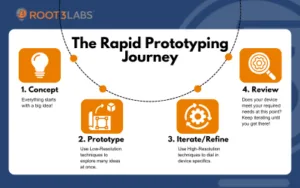
The answer should determine how much prototype complexity, time, and cost the next step requires. If a low-resolution prototype can answer the question, there is no value in overbuilding it. If the risk only appears in a more integrated system, the prototype needs to reflect that.
Depending on the system, that could include:
| Temperature | Power conditions |
| Vibration | Contamination |
| Shock | Interfaces |
| Structural load | Duty cycle |
| Pressure | Operator Interaction |
On one Root3 program, the technology already worked on the bench. The open questions were whether it could perform reliably enough for critical client demos and where energy efficiency, thermal performance, and connection reliability still needed work. Rather than treating the working prototype as proof that the system was ready to move on, the team focused testing on the risks most likely to affect the next milestone.
That is the shift from TRL 4 toward TRL 5: stop asking only whether it works and start proving whether it still works under the conditions that matter next.
See how Root3 worked through those risks in the full product development case study.
A focused prototype can be more useful than a more complete one.
The speed of building matters less than the speed of learning the right thing. A focused prototype, such as fabricating the connector panel and not the whole electronics enclosure, can answer one question quickly that could have delayed the project by weeks if we’d waited to get the whole system fabricated.
When a team already has substantial design work or test data but is unsure what the evidence supports, an engineering design review can help separate what is known from what is still being assumed.
How do you move from TRL 5 to TRL 6?
At TRL 5, individual technologies or subsystems may already have performed well under relevant conditions. TRL 6 raises the integration question. Now the system has to prove that those parts still behave as expected when they work together.
A component can pass on its own and still fail at the system level. Integration can change loads, electrical behavior, tolerances, or thermal performance in ways the earlier test never exposed. The useful question at TRL 6 is not simply whether the integrated prototype works, but whether the integration work has exposed the issues that could affect the next major commitment.
The right next step depends on what is still uncertain. That could mean analysis, a representative prototype, custom test equipment, or a targeted failure test.
The method should follow the uncertainty.
Proof before the baseline is set
On one Root3 aerospace program, the customer needed two large Ground Support Equipment systems engineered and delivered in ten weeks, with Critical Design Review in week three. The systems would handle up to 4,000 kg of rocket components, so the team validated the critical loads, connections, and safety factors before fabrication, then integrated and tested the full systems.
That is the TRL 5 to 6 shift in practice: proving that the system works together well enough to support the next major decision.
See the Ground Support Equipment proof example.
How do you move from TRL 6 to TRL 7?
By TRL 6, a representative system or subsystem has been demonstrated under relevant conditions. TRL 7 brings the hardware into the operational environment. At that point, simplifying assumptions has fewer places to hide. The team should be looking closely at whether performance still holds across the expected operating range.
Earlier tests may have relied on simplified interfaces or controlled support that will not exist in operation. At TRL 7, the prototype should be tested in a way that reflects how the system will actually be used.
The remaining question is not whether every uncertainty has disappeared. It is whether any open technical question is still capable of changing the next qualification, supplier, manufacturing, or program decision.
A useful TRL 7 conclusion sounds more like: Here is what we demonstrated, under these conditions, with these results. These risks remain open. This is what the evidence supports doing next.
Where Does Technical Risk Hide as Hardware Moves Out of the Lab?
Technical risk often appears where an earlier assumption meets a more realistic condition.
Interfaces
Components that worked independently now have to work as part of a larger system.
What this looks like in practice: On one of our recent aerospace projects, a mechanical linkage kept failing even though the FEA checked out. The issue was the fabrication sequence, which changed the material properties at the joint, so the finished hardware no longer matched the analysis assumptions.
Look for: interface, assembly, or fabrication assumptions that have not been verified on the actual hardware.
Environment
A bench test only proves performance under the conditions used in that test.
What this looks like in practice: On a medical-device project, chemical compatibility testing showed that the operating fluids were degrading the material and causing leaks.
Look for: operating conditions that could change performance or expose a failure mode.
Requirements and test coverage
A prototype can meet a requirement and still miss something that matters in use.
What this looks like in practice: While we were developing a mechanical prosthetic, a rubber grip worked in the lab but caught on clothing during user testing.
Look for: requirements or tests that do not reflect how the hardware will actually be used.
Manufacturing and suppliers
Manufacturing decisions can change how the hardware performs.
What this looks like in practice: In one design review, Root3 found a tolerance stack that required sub-0.005″ accuracy across most features, along with material and process choices that would have made production harder and more expensive. This is where building quality in early matters.
Look for: decisions that become difficult to change after CDR, supplier release, tooling, or fabrication.
What evidence should support a Technology Readiness Assessment?
Before the next major commitment, ask:
| Ask this | Look for this |
|---|---|
| What has actually been demonstrated? | Test results or analysis tied to a defined technical question or requirement. |
| Under what conditions? | A clear definition of the laboratory, relevant, or operational conditions. |
| Which assumptions remain open? | Risks stated explicitly rather than buried in the design. |
| What changed when the system was integrated? | Evidence from representative interfaces and system level testing. |
| Can the result be repeated? | Results that hold across units, runs, or defined operating conditions. |
| What does the evidence support doing next? | A practical recommendation tied to the milestone ahead. |
Pressure-test your program
Root3’s Hardware Readiness Diagnostic is a two-minute readiness check for hardware approaching a high-stakes decision. It is designed to help teams identify where the next commitment may depend on evidence they do not have yet.
When outside engineering support is useful
Outside engineering support is most valuable when the team has reached a decision point but the current evidence is not strong enough to make that decision confidently.
Sometimes the problem is narrow. A subsystem needs testing, a load case needs analysis, or a test setup needs to recreate the right condition. Other times, the team needs another perspective of the design before committing to the next build or program milestone.
A focused engineering design review can be a good place to start. It gives the team a clearer view of what the existing work supports, where risk remains, and which issues deserve attention before more time or budget is committed.
The right support depends on the decision ahead and the technical question still standing in the way.
Explore Root3’s engineering approach for advanced hardware.