Tough markets don't kill innovation. They sharpen it.
When budgets tighten and timelines stretch, the instinct is to pause. Wait for conditions to improve. Hold off on decisions until there’s more clarity.
But the teams that win during uncertainty aren’t the ones waiting. They’re the ones making small, targeted moves that compound into outsized results.
At Root3 Labs, we’ve helped MedTech, Aerospace, and Defense teams cut manufacturing costs 20 to 40 percent without redesigning their entire product. The secret isn’t massive transformation. It’s disciplined tweaks in the right places.
Here are the five small moves that deliver the biggest impact.
Our guide breaks down the five most expensive DFM mistakes we see, real case studies from our workshop, and a practical DFM Checklist for integrating manufacturing constraints into your design process before tooling commitments lock you in.
Chad is a professional engineer and has spent over 25 years leading complex engineering projects in medical device development and defense systems. He's been hands-on from early-stage prototyping to full-scale manufacturing, giving him unique insights into the challenges of bringing devices to market. Chad is always thinking about how to improve the development process to help clients save on manufacturing costs without reducing quality.
What are the best engineering tweaks to reduce manufacturing costs?
The five most effective engineering tweaks to reduce manufacturing costs are: (1) redesign for manufacturability by simplifying geometry and loosening tolerances, (2) implement assembly fixtures to reduce labor time, (3) second-source critical components for supply chain resilience, (4) use proof-of-concept prototypes before committing to production tooling, and (5) optimize existing processes by removing unnecessary approval gates. These changes typically reduce costs 20 to 40 percent without redesigning the entire product.
Key Takeaways
-
- Small design changes can cut manufacturing costs 20 to 40 percent
- Assembly fixtures pay for themselves in 3 to 6 months
- Second-sourcing critical components prevents 80 percent of supply chain delays
- Proof-of-concept prototypes (cardboard, foam, basic 3D print) answer fit questions in hours, not weeks
- Action: Audit your top 3 cost drivers this quarter and apply one tweak to each
1. Redesign for Manufacturability (Without Changing Function)
Your CAD model looks clean. But can it be manufactured without expensive tooling or multi-step processes?
Most teams design for function first, then hand off to manufacturing and hope for the best. That’s when costs balloon.
Small moves that help:
- Simplify geometry. Can you reduce the number of features that require secondary operations? Every undercut, every tight internal corner, every non-standard thread adds cost.
- Define tolerances with intention. If a tolerance isn’t critical to function, don’t define it as if it were. A plus-or-minus 0.005 inch that’s easy-peasy in machined steel could cost 3x more across a sheet metal bend.
- Standardize components. Use off-the-shelf fasteners, bearings, and seals instead of custom parts. Your procurement team will thank you.
- Design for the process. Injection molding has different rules than CNC machining. Sheet metal has different rules than 3D printing. Match your design to the process early.
Real example: A client was machining a bracket from solid aluminum. Four hours of machine time per part. We redesigned it for sheet metal fabrication with bent flanges for stiffness. Same function. Forty-five minutes of fabrication time. Cost dropped from $340 per unit to $85 per unit at low volumes.
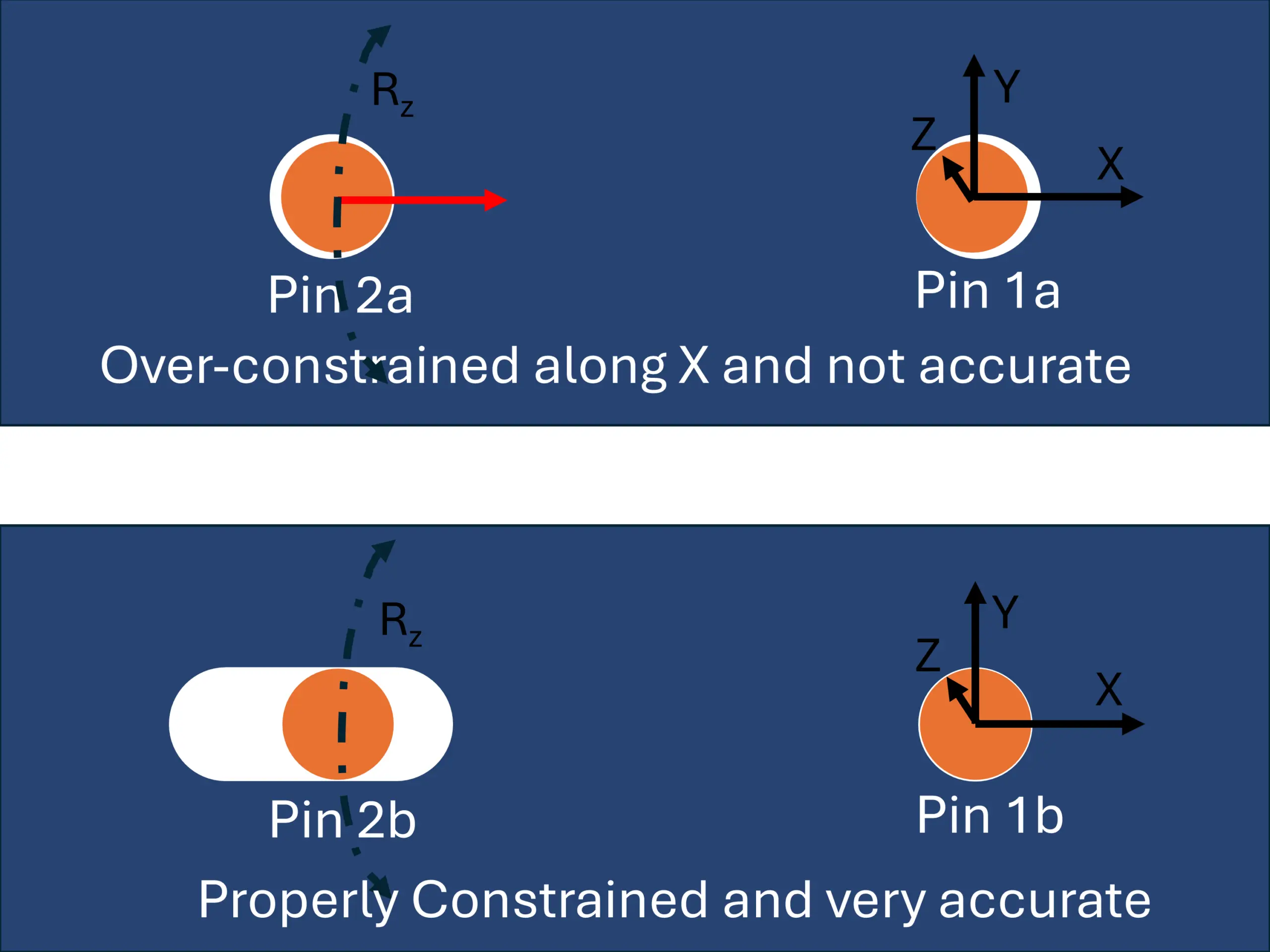
Over-Constrained Features Can Hurt Your Quality
- Two round pins into two round holes → both x and y must be perfect, on both parts. Any deviation = forced fit or misalignment.
- One pin + one slot → one feature locates, the other guides. Now the system can tolerate real‑world variation and still assemble smoothly.
2. Smarter Assembly Fixtures (That Pay for Themselves)
Assembly is where labor costs explode. Your engineers designed a beautiful product. Now a technician has to put it together by hand, aligning parts, tightening fasteners, and hoping for consistency.
A simple assembly fixture changes that.
What a fixture does:
- Holds parts in the correct position
- Reduces error and rework
- Speeds up training (new technicians get up to speed faster)
- Eliminates the need for complex jigs or custom tooling
Real example: An Aerospace rocket manufacturer was preparing to assemble eight 15m long panels into a 7m cylinder that would be launching into space. The panels needed to be lifted, accurately positioned, and rotated into alignment with each other to permit precision assembly. Oh, and the parts were arriving in 10 weeks! Find out how we designed and built the parts in time to meet delivery.
Regulatory Compliance? Done.
Assembly fixtures don’t require regulatory re-filing. The product design itself doesn’t change. You’re just making the process more reliable.
Cost Reduction Strategies Compared
| Strategy | Implementation Time | Typical Savings | Risk Level | Regulatory Impact |
| Loosen tolerances | 1-2 days | 15-30% per part | Low | None |
| Assembly fixture | 1-2 weeks | 30-50% labor | Low | None |
| Second-source components | 2-4 weeks | Prevents 80% of delays | Medium | Documentation update |
| Redesign for DFM | 2-6 weeks | 20-40% unit cost | Medium | May require filing |
| Process optimization | 1-3 weeks | 10-25% cycle time | Low | None |
3. Strategic Supply Chain Tweaks (Not Overhauls)
You don’t need to redesign your entire supply chain to build resilience. You need to identify the critical few components that, if unavailable, stop production.
Small moves that help:
- Second-source critical components. If a single supplier makes a custom part, you’re one disruption away from a shutdown. Find a second supplier or redesign for a commodity part.
- Identify long-lead items early. Some components take 20 to 40 weeks. Order those first, even before the rest of the design is finalized.
- Build redundancy for high-risk parts. If a component is single-source and mission-critical, keep a safety stock. The carrying cost is less than the cost of a line stoppage.
- Diversify geographically. If all your suppliers are in one region, you’re exposed to regional disruptions. Spread risk across multiple regions.
Real example: A client had a custom actuator with a 32-week lead time from a single European supplier. We qualified a second supplier in the U.S. with a 6-week lead time. Slightly higher unit cost, but production could continue during the European supplier’s delays. The client avoided a 4-month production halt.
Build with redundancy in mind.
Even if you don’t need it now, having 6-12 weeks of materials on-hand could get you through a sourcing delay or allow transitioning to a different vendor.
4. Proof-of-Concept Prototypes (Before You Commit)
Too many teams build high-fidelity prototypes before validating the core concept. They spend $50,000 and 8 weeks on a prototype that looks production-ready but fails on the fundamental physics.
Match your prototype to the question:
| Question | Prototype Type | Time | Cost |
|---|---|---|---|
| Will it fit? | Cardboard, foam, basic 3D print | Hours to 2 days | $50 to $500 |
| Does the mechanism work? | 3D printed parts, off-the-shelf motors | 1 to 2 weeks | $1,000 to $5,000 |
| Will users understand it? | Looks-like model, non-functional | 2 to 4 weeks | $5,000 to $20,000 |
| Can we manufacture it? | Production-intent, final materials | 4 to 12 weeks | $20,000 to $100,000+ |
Real example: A startup was building an Mealtime Assistance Chair for senior living facilities. We designed the lever components and 3D printed them, having a good idea where they’d fail. We fabricated structural 1/2 plastic pins with real delrin rods to give it a chance of success. After identifying some weak points, we built $2,000 CNC machined parts in ABS plastic and ran through the full battery of tests, including 5,000 actuations, which passed easily. We ordered the $50,000 in tooling with confidence, and First Articles performed beautifully.
Proof-of-Concept Procedure
Start low-resolution. Validate the riskiest assumption first. Then invest in fidelity.
5. Optimize Existing Processes (Not Reinvention)
You don’t need to reinvent your entire development process to see improvement. You need to identify the 20 percent of activities that cause 80 percent of delays.
Small moves that help:
- Document the critical path. What activities must happen in sequence? What can happen in parallel? Most teams discover they’re waiting on approvals that could have happened earlier.
- Reduce handoff friction. When work moves from mechanical to electrical to firmware, what gets lost? Create checklists. Require sign-off. Make the handoff explicit.
- Build in review gates. At key milestones, pause and ask: Are we solving the right problem? Is this design manufacturable? Have we tested the riskiest assumption?
- Track cycle time. How long does each phase actually take? Most teams underestimate by 30 to 50 percent. Measure, then plan accordingly.
The Compound Effect
Here’s the thing about small moves: they compound.
If one fixture saves 27 minutes per unit, over 10,000 units, that’s 4,500 hours of labor. At $35 per hour, that’s $157,500 saved.
One tolerance loosened saves $12 per part. Over 50,000 units, that’s $600,000 saved.
One second-sourced component prevents a 3-month production halt. That’s revenue that doesn’t disappear.
None of these moves required a redesign. None required new hiring. None required massive capital investment.
They required discipline. The discipline to ask: What’s the smallest change that delivers the biggest impact?
Frequently Asked Questions
Q: How much can small design changes really save?
A: Typically 20 to 40 percent on unit costs. In some cases, we’ve seen savings up to 75 percent when switching from machined to fabricated components.
Q: Do assembly fixtures require regulatory re-filing for medical devices?
A: No. Assembly fixtures are process tools, not product design changes. The FDA regulates the device, not how you assemble it (as long as you maintain quality system requirements).
Q: How long does it take to see ROI on a design review?
A: Most clients identify cost-saving opportunities in the first 2-hour session that pay for the review 10x over. Implementation takes 2 to 8 weeks depending on complexity.
Q: When should I use proof-of-concept vs. production prototype?
A: Use proof-of-concept when answering a question or validating the core concept (fit, function, user acceptance). Use production-intent when validating manufacturing processes, tooling, and supply chain.
Q: What’s the biggest mistake teams make with cost reduction?
A: Cutting costs on critical components. Never compromise on parts that affect safety, reliability, or regulatory compliance. Focus on geometry, tolerances, and assembly process instead.
When to Bring in External Support
Some teams handle all of this internally. That works if you have senior engineers across mechanical, electrical, and manufacturing disciplines, plus a fully equipped prototyping shop.
Most teams don’t.
Here’s when it makes sense to bring in external support:
- You have scientists but no hardware engineers. Common in MedTech startups founded by clinicians or researchers.
- Your team is at capacity. Your engineers are focused on current product lines. The improvement project keeps getting deprioritized.
- You’ve hit a technical wall. Your internal team has tried multiple approaches and can’t crack a specific problem.
- You need speed. Internal hiring takes 3 to 6 months. External teams can start in 2 weeks.
- You want a fresh perspective. Sometimes the best ideas come from engineers who’ve seen this problem in a different industry.
“Our process isn’t about perfection at every step. It’s about speed, quality, and reliability. We design, build, and test early and often to eliminate technical and manufacturing risks before they become expensive failures.”
The Professional Engineering Difference
Here’s something most product development firms won’t tell you: in Maryland and most states, providing engineering consulting services legally requires a licensed Professional Engineer and a registered Professional Engineering Firm.
Many design shops operate without this oversight. That means no formal accountability for engineering decisions.
At Root3 Labs, we’re a state-licensed Professional Engineering Firm. Our principal has 25+ years of device development experience across medical, aerospace, and defense. Every project carries that accountability.
Why does this matter? Because when you’re making changes that affect manufacturability, reliability, or safety, you need a partner who treats it that way.
Your Next Step
Pick one area from this list and apply it this quarter:
- Audit your top 3 cost drivers. Which components or processes consume the most budget? Apply one tweak to each.
- Identify your riskiest assumption. What’s the one thing that, if it fails, kills your project? Build a low-resolution prototype to test it.
- Map your critical path. What activities are on the critical path? What can be parallelized? Where are the hidden delays?
- Book a design review. A 2-hour session with our team can identify cost-reduction opportunities you haven’t seen.
Bottom Line
You don’t need massive transformation to see results. You need disciplined, targeted tweaks in the right places.
Small moves, applied consistently, compound into outsized impact.
That’s how you navigate uncertainty. That’s how you ship with confidence.
Ready to identify your small moves?
We offer 2-hour engineering design reviews to help teams identify cost-reduction opportunities and de-risk development early. Book a discovery call or learn more about our design review service.
Let’s talk about your current challenge. We’ll point you in the right direction—even if Root3 Labs isn’t the best fit.